
Accessible Introductions:
Articles about the research carried out in our laboratory.
• Interview with students in Yoshida Laboratory (Power Academy, “People in Electrical Engineering”).
• Introduction for junior and senior high school students (Kawaijuku Miraibook, “Creating a Small Artificial Brain on a Microchip”).
• Essay on our research (Chuo Online, “Machines Becoming Biological and Organisms Becoming Machines”).
Technologies Studied in the Laboratory:
The following technologies can be learned in Yoshida Laboratory. We teach them in depth in the laboratory and graduate classes, and plan to add accessible explanations here. Please check back later. Asking ChatGPT or Gemini can also be a useful way to study.
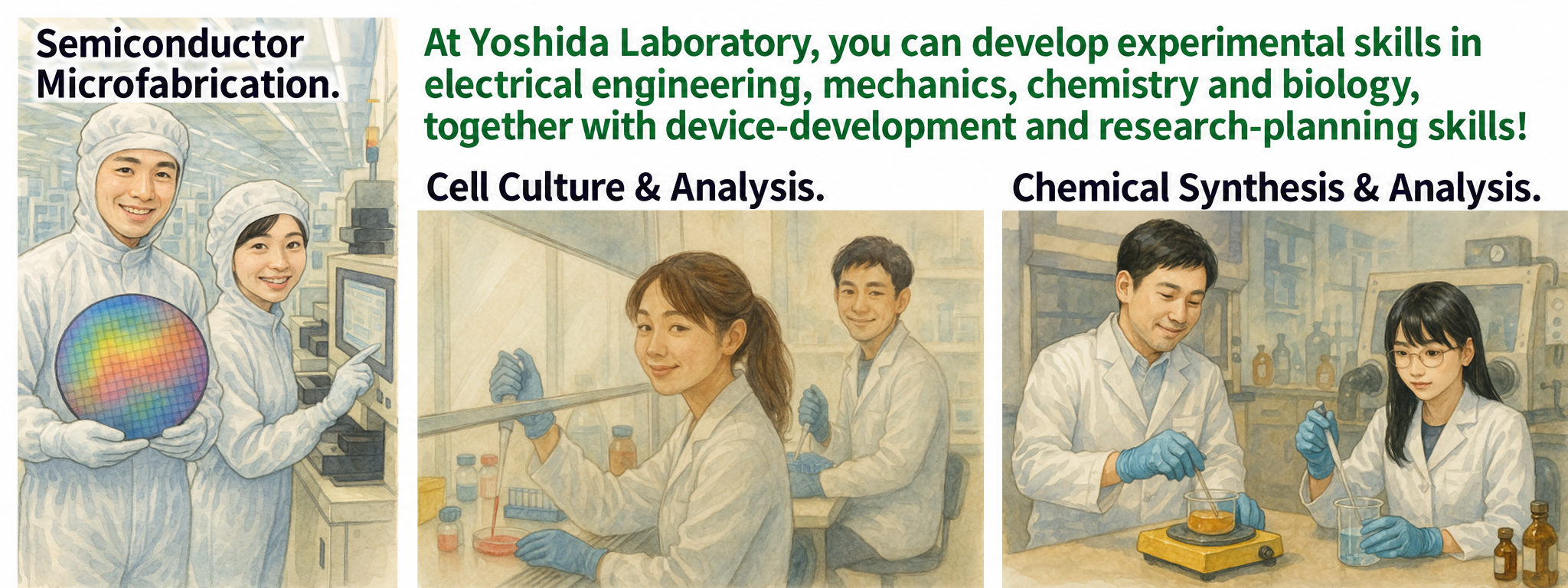
Organic electronics, bioelectronics, bio-MEMS, semiconductor microfabrication, printing technologies, flexible electronics, wearable electronics, skin electronics (E-skin), cyborg technologies, biofuel cells, hydrogel batteries, microneedles, electroosmotic flow, soft robotics, cell culture, organic polymers, aerogels, porous materials, neural engineering and skin engineering.
For Students Taking Our Classes:
Course materials are normally distributed through manaba, but are also available from the links below. Each page requires the password announced in class.
A textbook on electronic circuits and explanatory articles on organic electronics and bioelectronics are planned.
- Electronic Circuits 1 (required course, second year, autumn semester). Details: syllabus
- Electronic Circuits 2 (elective course, third year, spring semester). Details: syllabus
- Advanced Organic Electronics (graduate course). Details: syllabus
- Advanced Bioelectronics (graduate course). Details: syllabus