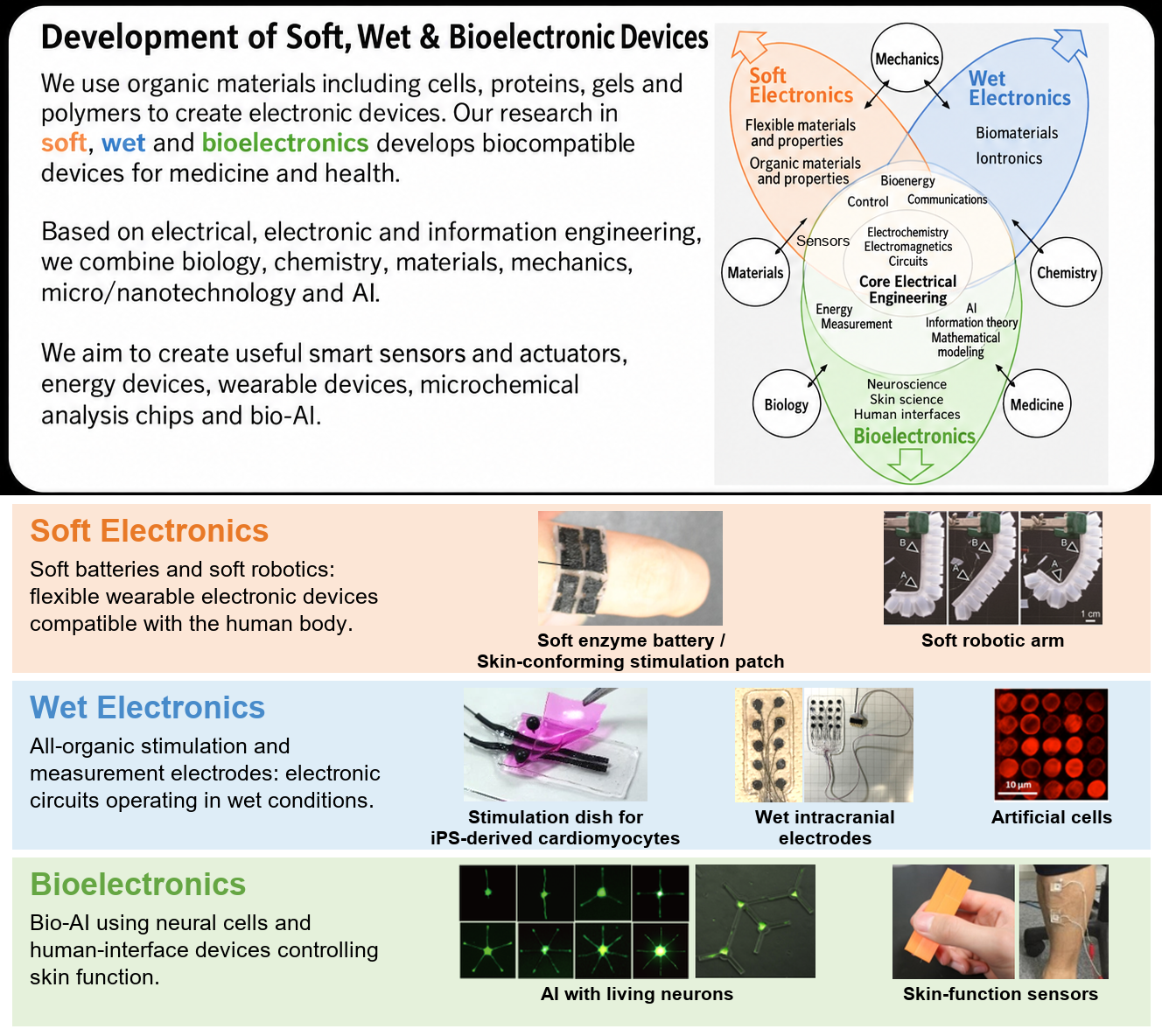
Yoshida Laboratory conducts research in organic electronics and bioelectronics.
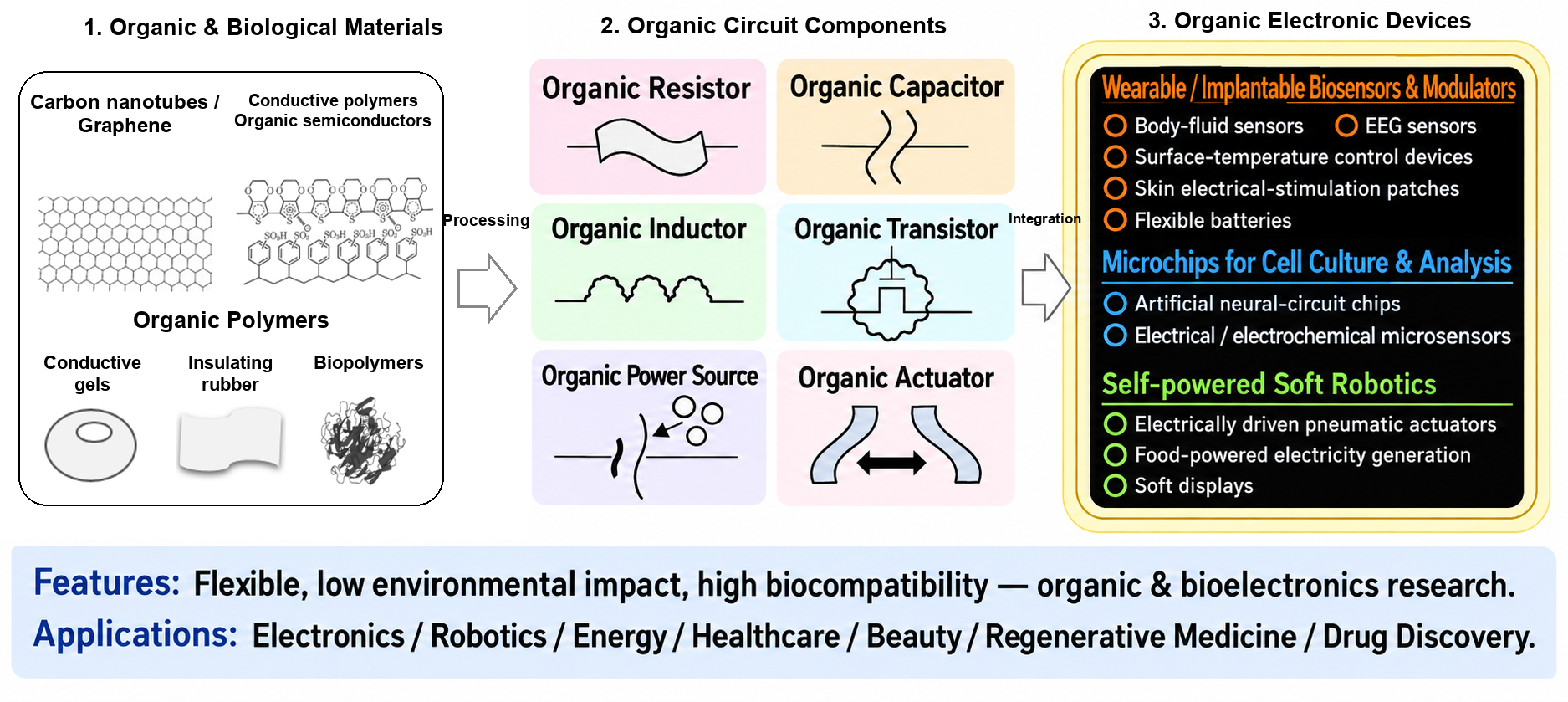
We explore electronics and iontronics based on organic and biological materials, including carbon nanomaterials, conductive polymers, organic semiconductors, gels, proteins and cells. We aim to contribute to a sustainable society by developing organic electronic devices that use organic materials and biomass with a low environmental impact. Potential applications span environmental technology, energy, medicine, drug discovery, healthcare and beauty. Building on electrical, electronic and information technologies, we draw on mechanical engineering, biology, chemistry, materials science and micro/nanoengineering, including semiconductor microfabrication and MEMS, to create new devices.
For students: You can pursue research that interests you under faculty supervision. Our projects are primarily experimental and involve building microchips, sensors, actuators, semiconductor electronic circuits, energy devices and wearable devices. Our department’s undergraduate courses offer limited coverage of organic materials and biology, but no prior knowledge of these fields is required: you can learn after joining the laboratory. A grounding in electrical and electronic engineering is needed, so please build a solid foundation through your coursework.
Research Topics
- Printed soft organic electronic circuits: We develop semiconductor microfabrication techniques that use organic conductive inks and gel substrates to print semiconductor and electronic components, including resistors, capacitors, inductors and transistors.
- Flexible and wearable organic batteries: We develop energy devices made from organic materials that are friendly to people and the environment and soft enough to conform to the human body.
- Skin electronics and biomedical engineering: We use microneedles to connect electronic devices with the skin, developing devices that deliver small electrical currents for applications in beauty and healthcare.
- Biocompatible organic electrodes: We process and combine hydrated organic materials to develop implantable sensors for electrical and electrochemical measurements, as well as electrical stimulation devices that function in wet environments.
- Organic soft robots: We build actuators entirely from soft organic materials that are friendly to people and the environment, and study robots with lifelike behavior.
- Artificial neural electronics and bio-AI: We aim to create new forms of artificial intelligence by controlling living neural cells on microchips and building artificial brains.
- Organ-on-a-chip systems for regenerative medicine and drug discovery: By controlling cells on microchips, we build biomimetic organ-on-a-chip systems for drug discovery and the engineering of organs.
Graduate students present their research at academic conferences. See the following Lab News posts for details of individual students’ projects: 2025/2024/2023/2022/2021